


Asian Cup Debuts in Haikou: How Events Drive Urban Growth
 Source:

From February 4 to 8, the 35th ITTF–ATTU Asian Cup took place in Haikou. The tournament attracted a total of 78,500 spectators both on and off-site and generated an estimated economic impact of CNY 443 million. It was the event's first time being hosted by Haikou and the first major international sporting event held in Hainan since the launch of island-wide special customs operations of the Hainan Free Trade Port (FTP).
Why was this premier event served to Haikou? How did the city rise to meet this challenge? Moreover, what broader ripple effects has the event generated for Haikou and the Hainan FTP?
Why Haikou?
For five straight days, Wuyuanhe Stadium was buzzing with energy. Fans cheered every winning shot and supported players during setbacks, as their chants and applause resonating throughout the arena.
This is undeniably where the charm of top-level competitions lies.
During the bidding stage, Haikou faced stiff competition from cities such as Shenzhen, host of the previous Asian Cup, and Hangzhou, host of the 19th Asian Games. So how did Haikou ultimately secure this premier event?
A look at the Chinese Table Tennis Association’s bidding criteria offers us some clues.
In terms of infrastructure, Haikou proved to have strong hosting capacity. It met all the requirements for venues, services, and operational experience. Wuyuanhe Stadium, a modern multi-purpose facility, fully meets ITTF standards and was praised by national team players, including Sun Yingsha, Kuai Man, Wang Yidi, and Chen Xingtong, after the competition.
Experience also played a key role. From the Volleyball World Beach Pro Tour to the 2025 IWWF Wakesurf World Cup and China’s professional football leagues, a steady stream of international and domestic events has garnered Haikou strong expertise in event management.
Supporting conditions further strengthened its case. Supported by the Hainan FTP’s favorable policy advantages, location, and year-round mild climate, Haikou provides a highly competitive environment for major events. For example, visa-free entry for travelers from 86 countries makes it easier for international athletes and officials to participate, while numerous air routes ensure convenient travel. Its spring-like weather also offers ideal conditions for winter competitions, benefits that are difficult to duplicate elsewhere.
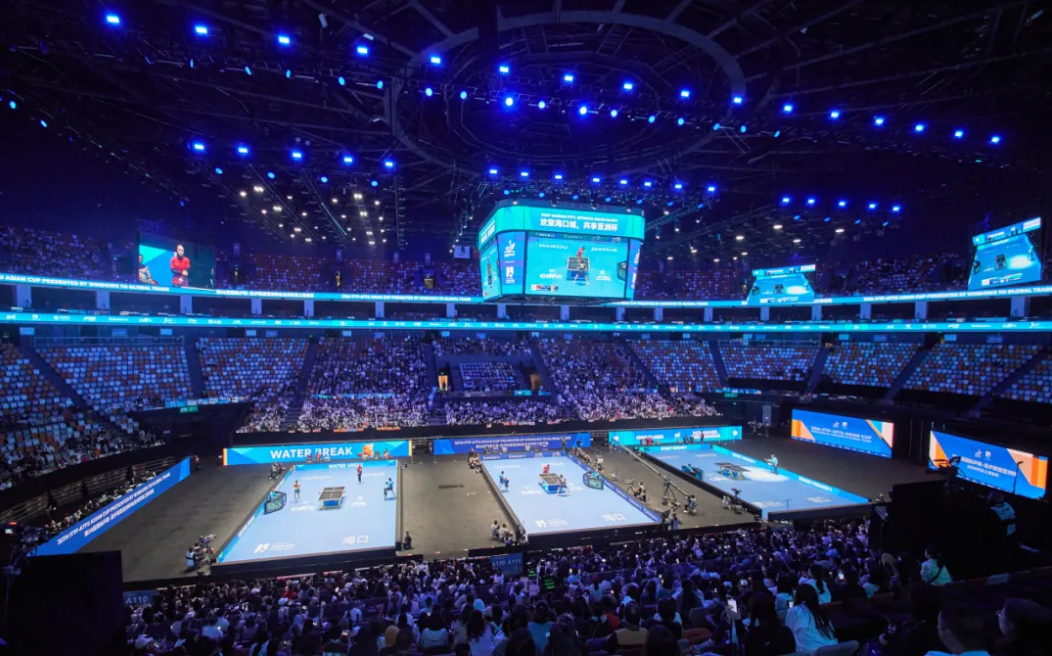
Opening day action at Wuyuanhe Stadium on February 4th (Photo: Hainan Daily / Feng Shuo)
The city’s proactive approach was equally important. Provincial and municipal leaders actively engaged with national sports authorities throughout the bidding process and the mayor personally delivered the final presentation. These efforts clearly signaled Haikou’s determination to host the event.
That determination comes from a deep understanding of what major international events can bring to their host. As Wang Liqin, President of the Chinese Table Tennis Association, noted at the opening ceremony, hosting the Asian Cup in Haikou has special significance against the backdrop of the Hainan FTP’s development. It is not only a major Asian sporting event but also an opportunity for China to showcase its leadership in reform and opening-up.
With the ball in its court, Haikou seized the moment to showcase itself to the world, successfully hosting a high-level competition and giving a substantial boost to its city brand.
How was the event delivered?
Successfully staging the event required both professionalism and thoughtful service.
To ensure an exceptional competition experience, Haikou established an event command headquarters led by the mayor, bringing together 18 government agencies and 10 specialized task forces. Together, this system provided comprehensive support for event management, security, transportation, medical services, and publicity.
Efficiency was apparent in every aspect. At Haikou Meilan International Airport, two dedicated “Haikou Asian Cup” immigration lanes were established with multilingual officers on site, allowing for quick clearance. Singaporean player Zeng Jian praised the setup, saying, “The clearance process was very smooth. Such an excellent experience has made it much more convenient for us foreign competitors.”
Beyond efficiency, the city aimed to create a welcoming experience, knowing that thoughtful touches can leave a more lasting impression.
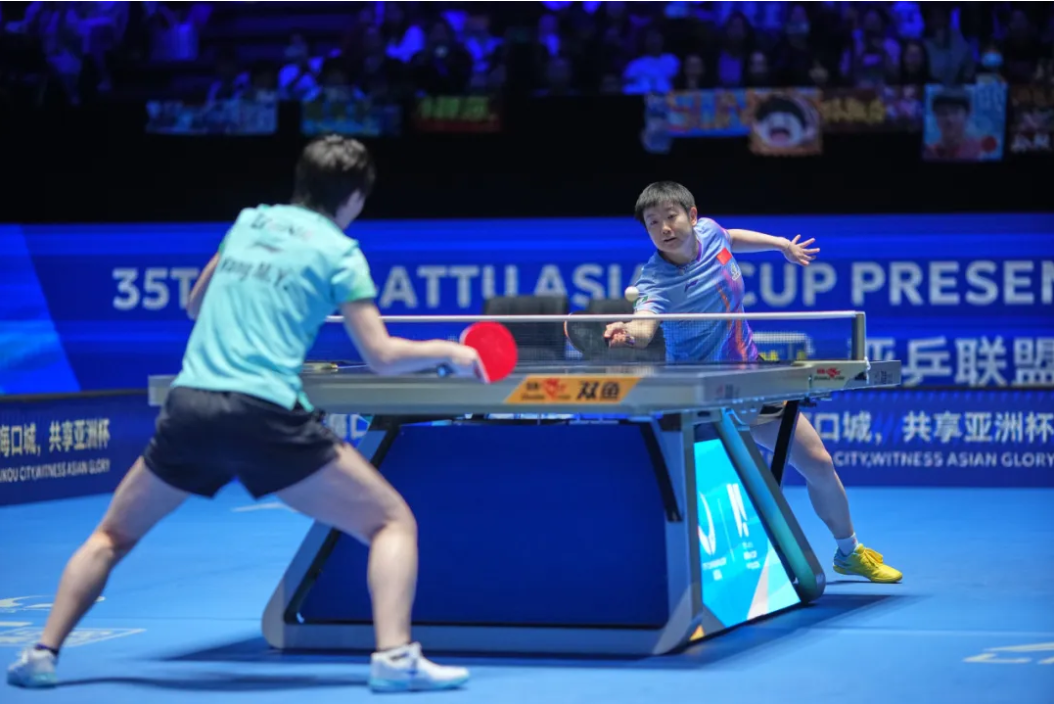
Sun Yingsha celebrates her women’s singles title (Photo: Hainan Daily / Feng Shuo)
Fireworks at the welcome banquet, over 300 ticket-based discounts covering dining, hotels, transportation, and shopping, and nine free bus routes helped visitors feel truly welcome. The “Asian Cup Park” beside the stadium and live viewing zones across 18 commercial districts extended the excitement throughout the city, turning the tournament into a citywide celebration.
This coordinated effort showcased Haikou as an efficient, friendly, and vibrant modern international city, while projecting an open, inclusive, and pragmatic image of the Hainan FTP to the world.
What were the impacts?
As the premier tournament in Asian table tennis, this year’s Asian Cup drew widespread attention, boosted by the return of star players like Sun Yingsha and Wang Chuqin.
The impacts of the event have invigorated Haikou and the province in multiple ways.
The influx of visitors was the most immediate outcome. On a larger scale, the event drew 78,500 spectators both on and off the site, with 55% coming from outside the island. Locally, from dedicated fans arriving on crutches to spectators traveling nearly 50 hours by train across provinces, the enthusiasm clearly showed the Asian Cup’s strong appeal.
This was accompanied by an extensive boost to the city’s image. After the matches, players like Sun Yingsha, Kuai Man, and Wang Yidi shared their positive thoughts about the city: “The air is fresh,” “The temperature is comfortable,” and “I hope to visit Haikou again.” Media coverage of their comments naturally attracted considerable attention to the city.
Spectators also took the opportunity to visit Hainan, learn about it, and even fall in love with it, becoming “local ambassadors” for the Hainan FTP. Zhang Ziying, a 17-year-old table tennis fan from Guiyang, Guizhou, bought tickets for both the opening day and the finals.
During the days in between, she traveled between Haikou and Sanya using the island’s high-speed railway and later shared her trip experience on social media, unintentionally promoting Hainan tourism. The domino effect of “event-driven traffic benefiting the whole island” became clearly evident.
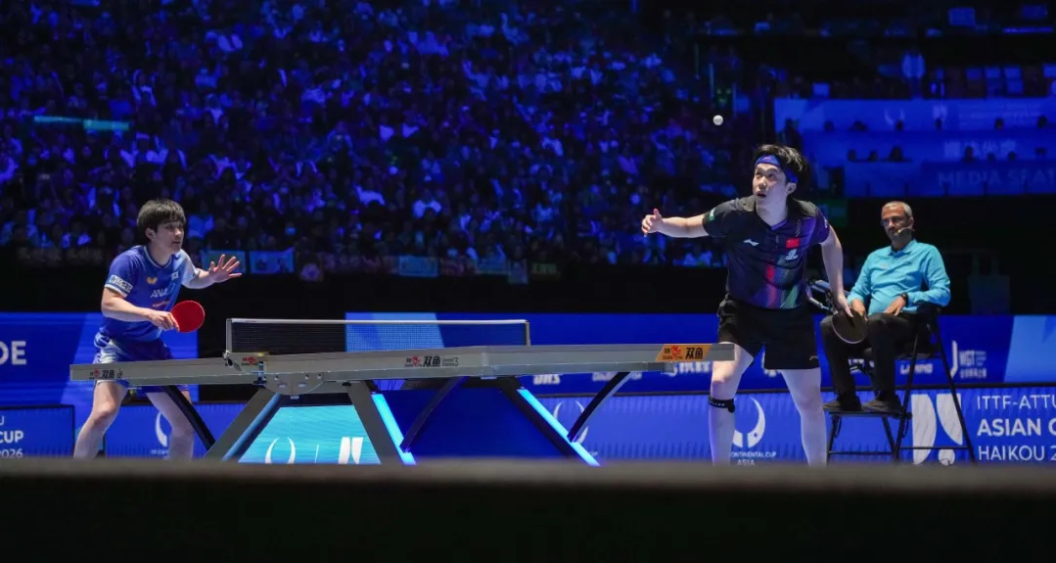
Wang Chuqin wins the men’s singles final (Photo: Hainan Daily / Chen Yuancai)
The economic boost was equally striking. During the competition, hotel bookings around the venue surged by more than 150% year on year. Within a three-kilometer radius of the stadium, occupancy rates of high-end hotels exceeded 90%. The strong figures highlighted the integration potential of sports with tourism and consumption.
More substantial impacts lie in industrial cultivation and enhanced urban capacity. Local enterprises participated in the event, and local sports-related business entities gained valuable experience in operating international competitions, laying a solid groundwork for hosting higher-level events in the future.
The success of the tournament also demonstrated to the world that Hainan not only possesses unique advantages for hosting events but also the capability to organize them well. This will undoubtedly aid the province in attracting sports-related industries, capital, and talent to settle on the island and fostering a local sports industry ecosystem.
Although the competition has concluded, its effects continue to ripple across Hainan, with future high-profile events expected to further elevate the province’s international profile and add fresh momentum to the development of the Hainan FTP.
Copyright 2021 Foreign Affairs Office of Hainan Province. All rights reserved.
Copyright 2021 Foreign Affairs Office of Hainan Province.
All rights reserved.




 PC
PC